

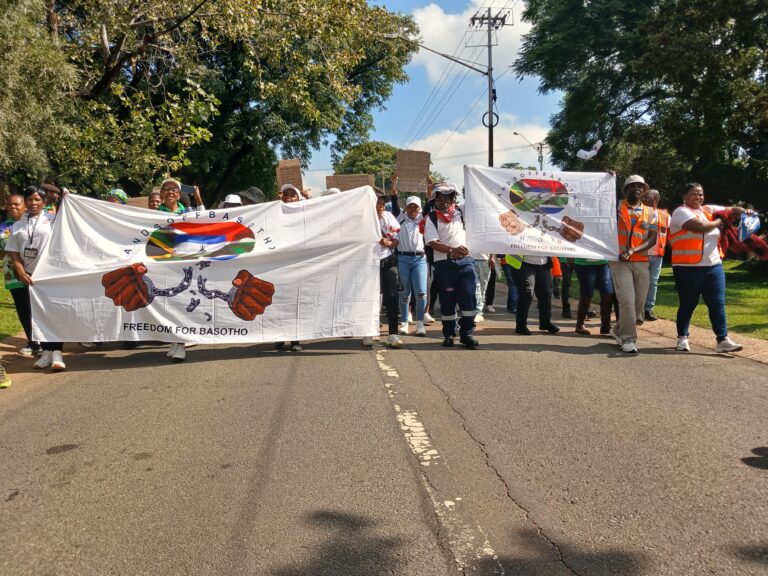
Bastho Nationals Want Their Embassy to Come to Their Aid

Hundreds of Basotho nationals marched in protest to their county’s embassy in Tshwane on Monday to demand that the embassy must come to their aid on various issues that they encounter in South Africa as foreigners.
Marching under the banner of an organisation called Hands Off Basotho, the marchers decried the passive attitude shown to them by their embassy.
“The Lesotho government embassy in South Africa doesn’t care about the Basotho nationals as the Basotho nationals get killed; are arrested illegally and imprisoned for more jail time than that for which they have been sentenced,” said founder and president of Hands Off Basotho organisation Justice Semenyane.
He denied reports that they were marching for the purpose of being allocated working permits and passports by their embassy.
He appealed to all Basotho nationals to stop isolating themselves but come out in the open to work together with other Basotho nationals for the betterment of their lives in South Africa.
He asserted that the Basotho nationals are hard-working people who are here in South Africa to make an honest living.
He appealed to the South African government to make arrangements with the Lesotho government whereby they as Basotho nationals won’t be required to produce work permits when seeking employment in the country.
“I have been staying and working in South Africa for over two years now and we are here at the Lesotho embassy to highlight the fact that we are ill-treated here in South Africa, yet our embassy doesn’t do anything to help our lot and it is like the Lesotho embassy doesn’t exist at all here in South Africa,” said one of the marchers Malineo Kwetle.
“Other government embassies work hard to enhance and protect the rights of their citizens in South Africa but our government is silent and from now on going forward we want to see the embassy working for the betterment of the Basotho nationals,” she said.
Another marcher Mpho Tukisi told Tshwane Talks that they as Basotho nationals are subjected to bad treatment in South Africa: that they are not free to walk the streets of South Africa; and that citizens of South Africa don’t speak to them in a polite manner wherever they go.
“We want to be free in South Africa because South Africa also belongs to us and the freedom thdr we want is to walk the streets without fear of bring harassed and arrested,” he said.
Yet another marcher Mohenyane Selatela told Tshwane Talks that many Basotho nationals can’t be employed but get arrested for not having work permits in South Africa.
He emphasised the fact that there are no jobs in Lesotho and as a result they came to South Africa to look for the proverbial greener pastures.
“It is the second time that we are approaching the Lesotho government embassy to come to our aid on various issues and we were promised back then that our concerns shal be adhered to, yet nothing has been done in thdr regarding up until now,” he said.
He said it costs R120 for a Lesotho national to obtain a work permit.
Matshidiso Agnes Monyane said she came to South Africa in 2018 due to lack of job opportunities in her home country of Lesotho.
“In Lesotho we are often subjected to what is called short time work and in some cases we spend about two months without working at all and besides feeding our children we also have to pay school fees for them or else they get expelled from school,” she said.
“Unlike in South Africa, there are no-fee-paying schools in Lesotho and there is also no grants for children and unemployed people; the only people who earn social grants are the elderly citizens,” lamented Monyane.
She said in South Africa available jobs for Basotho nationals are in the domestic work sector but that they get exploited and fired unfairly most of the time as the employers know that they as foreigners don’t have rights in South Africa and no one will come to their aid.
She said that they rely on 90-day visas to be in South Africa and have to constantly go back to Lesotho to renew those visas and that thhs costs them lots of money in terms of transport.
“Now to make matters worse, we have to pay bribes before getting passports from Lesotho and I personally paid R1000 for a passport,” she said.
She complained that the Lesotho government doesn’t give a damn about them as its citizens and pointed out that about 400 Lesotho citizens who had been subjected to forced labour in Kwa Zulu Natal Province were not helped by the Lesotho government to be freed from their captors while Chinese nationals who had been subjected to forced labour like the Basotho nationals were freed by their government.