
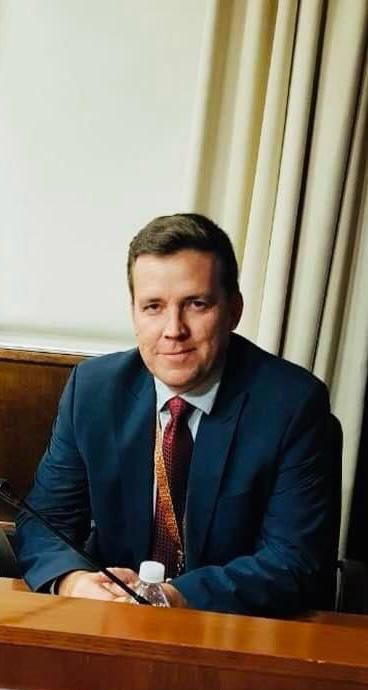
 Adrian Roos MP DA Spokesperson on Home Affairs
The issue of illegal foreigners is going to take centre stage in the forthcoming 4 November 2026 Local Government Elections and Tshwane Talks had an opportunity to engage DA Member of Parliament Adrian Roos to get an insight as to what the DA’s stance is in this regard.
Roos speaks for the DA on matters concerning Home Affairs.
Tshwane Talks – Adrian Roos MP (DA Spokesperson on Home Affairs)
1. What is the DA’s stance regarding the issue of illegal foreigners?
The DA stands firmly against illegal immigration, as a violation of immigration law and other national laws.
The party’s position is anchored in the rule of law. Violation of the law must be addressed decisively through correct administrative and legal procedures by law enforcement, not vigilante groups.
However, the DA explicitly rejects the scapegoating of migrants or the use of violence against them, maintaining that protecting human rights, dignity, and equality for everyone within South Africa’s borders is non-negotiable.
2. How can this issue of illegal foreigners be resolved once and for all according to the DA?
This won’t be done through simplistic actions such as, for example, just deporting everyone.
The DA proposes actions at the borders, in our cities and in our workplaces to resolve illegal immigration:
* Restoring Asylum Integrity: Implementing the “First Safe Country Principle,” which requires asylum seekers to apply for protection in the first safe country they reach, thereby ending “asylum shopping”. Legal action brought by DA’s Home Affairs Minister Leon Schreiber recently saw the courts rule that asylum applicants can no longer resubmit applications endlessly. The DA is closing loopholes for ‘economic migrants’ while still processing the applications of genuine asylum seekers.
* Technological Border Control: The Minister recently announced a R12,5Bn redevelopment of our six major land ports and has been deploying drones, body cameras, and heat-mapping technology to detect and intercept illegal crossings in high-risk areas. This has resulted in a 24% drop in attempted illegal crossings.
* Digital Identification: Creating an Intelligent Population Register (IPR) and Digital ID system that includes biometric data for all foreigners, allowing law enforcement to instantly identify visa overstayers and undocumented individuals. Foreign visitors were not before required to provide their biometrics, making it difficult to law enforcement to identify and prosecute them.
* Workplace Accountability: The Digital Identification system allows for the introduction of an e-verification system that requires employers to check the legal work status of potential employees against a Home Affairs database.
* Firm Enforcement: Ramping up legally-compliant deportations (over 600,000 have been deported since the formation of the GNU) and conducting targeted operations like Operation New Broom in “hotspot” areas. In the last year there were over 10,700 internal immigration enforcement operations (the target was 4,000) across South Africa.
* Tough on Corruption: Working with the SIU, Minister Schreiber has been decisive on corruption, with arrests, dismissals and the issue of body worn camera to stamp out corruption.
By closing access to opportunities and dramatically increasing the prospect of being caught.
3. Does the DA subscribe to the preamble which has been interpreted to the effect that South Africa belongs to all who live in it including foreigners and illegal foreigners?
The Constitution is our supreme law, but the right to freedom, for example, is not absolute. Section 36 indicates where rights may be limited and breaking the law can trigger this.
The DA’s policy states that it upholds the Constitutional rights guaranteed to everyone in South Africa, including migrants, asylum seekers, and refugees, as provided in the Bill of Rights.
It acknowledges that while some rights (like political participation) are reserved for citizens, others such as dignity and equality before the law, apply to all.
However, the DA clarifies that the protection of these rights requires compliance with the law, and they believe the state has a sovereign right to manage citizenship and immigration in the national interest.
We passed the Immigration Amendment Bill at the end of last year to speed up the processing of illegal immigrants so that they don’t stay in our prisons for excessive amounts of time or get let off on bail for technicalities.
But this law still requires them to be treated with the rights afforded to any other detainee and not be treated differently just because they are a foreigner.
4. According to your knowledge is there any country in the world where foreigners are allowed to come into that country illegal and be employed as domestic workers, factory workers and restaurant workers?
No such country exists, but it is important to remember it is not the country who employs undocumented foreign nationals, it is business owners and citizens.
Home Affairs Minister Leon Schreiber is taking bold moves to deal with illegal immigration, but too often Metros fail to enforce by-laws in human settlements, our public parks and areas of trade, and SAPS are accused of taking bribes instead of making arrests.
Cilliers Brink was in Sunnyside last night showcasing the clear lack of enforcement. So it cant just be Minister Schreiber working, the other arms of government such as local government and citizens themselves have a critical role to play.
5. Has the DA ever raised the issue of illegal immigrants for debate in Parliament?
For sure. The DA has recently driven a motion in Parliament on the risk to national security of the continued underfunding of the Border Management Authority, and recently almost R1Bn more was allocated by Treasury to secure our borders.
The debates in Parliament on Illegal Immigration are, unfortunately, used by certain political actors to grandstand and use illegal immigration to gain votes instead of providing any workable solutions.
The DA is the only party in Parliament that is taking concrete steps to cover all the bases of illegal immigration. The proof of the pudding is in Tshwane, for example, where they have the keys to power but apart from occasional raids the day to day by-law enforcement work is sorely lacking.
It is in the absence of rule of law that illegality flourishes and this is why it is so important to get back Cilliers Brink as Mayor of Tshwane to return the rule of law to Tshwane.
Tshwane Talks readers have been able to read stories in this publication for free for over two years now. We still want our readers to access our stories for free, but we are asking those among our readers who can afford it to contribute at least R30 a month to cover some of the costs of publishing this independent, non-aligned online newspaper which gives a voice to all sectors of society irrespective of race, colour, creed, religion, or political affiliation. You may make your contribution by depositing at least R30 a month into Tshwane Talks' bank account. Details are as follows:
Bank Details
Bank: Standard Bank
Account Number: 10225548834
Account Type: Cheque Account