
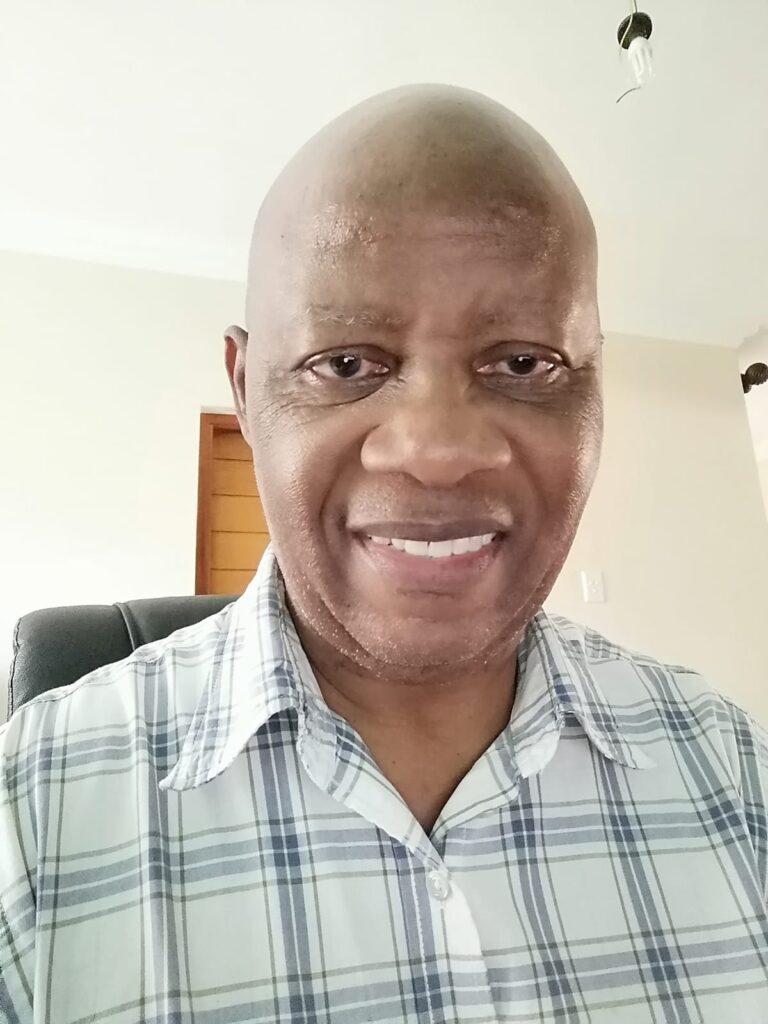
 Selby Vusimusi Moyo
Activist
By Vusumzi Moyo
Activist
We arrived at the VA Waterfront at around nine, too early for a ferry scheduled for 11h15.
With about an hour and few minutes to spare, we went for a light breakfast.
We couldn’t afford to miss it because it would have meant we had wasted resources.
By the time we made it back, the gate was open and we joined other passengers filing in.
On the ferry to Robben Island (SA’s Gyaros or Leros) I was preoccupied with one thing.
The humming and bouncing of that boat could not stop the mind from working.
I could have had a nap, which is what I needed after the sleepless night I experienced.
I looked out at the expanse of the ocean.
I couldn’t believe I was on the Atlantic Ocean – – I have only been as far as its shores. But today I was traveling in it! For many it was tourism, but I believe for me, Arthur and Molefe it was a spiritual journey, or a reconnection.
And for what we heard the previous day has preoccupied us since we left Phillipi.
And now, on the boat, which seemed to be on a journey to eternity, I couldn’t help but think of the bravery of Makana (or Makhanda).
As I saw the other ferry going in the opposite direction, I knew his was sheer power of the will to be free.
His daring escape from this island prison was testament to that.
For that distance, one could explain his act as breaking away from the evil in some human beings.
No matter nothing more was heard of him, he must have inspired those imprisoned many years after him.
Just as certainly some – – like, for example, Jafta Masemola – – were planning an escape themselves.
Others had to gather strength and develop great resilience, to stay on.
Signs of life appeared on the left side of where I was seated.
It was an island, alright, but it didn’t appear to be the one time prison island we were heading to.
More so that we were moving farther to the right from that piece of land.
The houses we were seeing didn’t seem to be anything like a prison.
Probably those developed by Luyanda Mpahlwa, himself a former prisoner.
The older buildings were designed by several people, including John Bell.
The ferry had been moving for 35 minutes, now.
Arthur told me it was announced that it was indeed our destination, but I had probably missed that.
And I was not convinced, until a few minutes later the ferry reduced its speed for us to see the prison structures and allow the boat to get to the dock.
A second announcement was made for us to remain seated until the ferry came to a complete halt.
A few meters away another boat was docked and people were alighting to walk to the buses a little distance away.
We had arrived!
The group was divided into two to avoid congestion, and so that the guide would not strain to be heard by the last person at the back.
Maybe a sound system could come handy.
We were ushered into the reception where the prisoners were profiled and given their number identities and Island passes.
Prisoners had numbers – – people were reduced to mere numbers.
Their humanity ceased.
Our guide, also a former prisoner there, later informed us that losing the pass meant one could miss food rations and other ‘privileges’.
That’s turture!
The reception had in it handcuffs, leg chains, and a register, in one glass display encasement; the other encasement displayed prisoners’ uniform: green shirt and brown trousers, as well as brown shoes which looked like they were never polished since they were issued to whomever had worn them.
This is where visitors started taking photos.
I am not sure if we paid attention to what was being said because we wanted to see more than listen.
The one time we were really in one place and listened attentively was in Section D, which had been the section for prisoners from what was colonial South West Africa (Namibia.)
It was here also that we were told about the poor, unsanitary ablution system. Sixty prisoners shared a communal non-flushing (bucket) toilet.
One could just imagine how this was – – what came to mind are some of the ‘informal settlements’ that came with the so-called freedom! I am sure you too can picture that.
There are boards of the summarised history of German colonialism and pictures showing what cruelty was meted against African people there.
There were blankets, mats and bunk beds, I supposed left in the same way the prisoners left then when they vacated the prison.
This is where we learnt that even on the Island segregation policies were enforced.
Here, the prisoners were not just prisoners: they were Indian prisoners, ‘Coloured’ prisoners and ‘Black’ prisoners.
Even the food rations they were apportioned, which were clearly written on a board, were not the same.
For instance, whereas Indian prisoners were given jam and syrup with their breakfast, African prisoners (‘black’ prisoners here) got only syrup.
What was also conspicuous was the Phuzamandla (a nutritious beverage) reserved for Africans.
A huge blunder by the authorities if they had meant to spite the African prisoners.
Growing up, this was a delicacy for us children!
It was in Section D where we also saw the list of prisoners who died on the Island.
One notes that the presentations were short and the guides could not possibly cover everything when visitors seemed to be streaming in throughout the day.
Somehow you understood that the guides could not maneuver their way out of the prescribed script.
Only when we were given opportunity to ask questions were they able to expatiate.
For instance, when a question was asked about attempted escapes by prisoners were we told about Jafta Masemola who fashioned a “skelm” key from a copied model on a bar of soap.
Even so, concentration was on the attempts in the 1800s by African chiefs who were recaptured.
And hardly did we hear about the familiar escape story of Makana (Makhanda) whose death remains a mystery.
From this section we were led to Section B which was designated for prisoners who were serving life sentences.
We entered through an opening that led us to a quad, which was, we were told, a recreation area for prisoners.
Our guide pointed to a spot near the wall, which was designated “Mandela’s Garden”.
We wondered why the walls were so high when they, as well as the window burglar bars and doors, were so thick.
Perhaps the authorities and the prisoners knew better.
Hence the attempted escapes of which we were told.
The only cell we were told the resident of was the fourth from the door, that which once housed Nelson Mandela.
In it was a mat, neatly folded blankets (as per the discipline of the prison), a small wood bench on which were a silver plate and a mug.
I wonder what might have happened to the items in other cells – – they seemed to be not as complete as those in Mandela’s cell.
Sections A and C are the only ones we did not visit.
There was no reason proffered for not visiting them, and no one asked why not.
I surmised they were for the general prisoners, so there was not much to be said about them.
The three of us were among a few last of the visitors, maybe because we had many questions.
We were not shown Masemola’s cell.
Don’t visitors deserve to know he was very resourceful, and that he agitated for improved conditions for prisoners?
As one of the first to be sentenced to life imprisonment on Robben Island, and the longest serving prisoner, wasn’t it fitting for the guides to spend time relating his story?
Are the current authorities ashamed that the narrative that they have fed the world about Mandela having spent 27 years there is a lie, and they cannot bear answering questions from visitors to the Island?
That it is better for the lie to remain the way it is, that by some miracle people will believe it?
But how, when it is some of the long-serving prisoners are telling it like it is?
It would be foolish to continue a lie about history, anyway.
Wouldn’t it be?
The other striking omission of the presentations is that about the burying alive of Johnson Mlambo, exposing only his head and face over which wardens are said to have pissed!
What would happen if such cruelty was exposed?
As it is, being on the prison of that sort for issues relating to seeking freedom was on its own a human rights violation.
Speaking about incidents such as that which happened to Mlambo is something that the world should know – – the cruelty of Robben Island, and healing.
Afterall, South African police of the apartheid era are notorious for killing detainees.
Surely, the world knows about that, so there should not be need to hide those facts about the Island.
In fact, that should make people curious and to come and visit.
It would also be interesting to see where the incident happened.
The real spoiler was when we were not allowed to go see the building that had incarcerated Mangaliso Robert Sobukwe.
We did not see the actual building which was Sobukwe’s ‘home’ on the Island.
Whereas pictures we have seen of that house showed it as a small structure, those buildings we were shown represented something different, and were freshly painted in a different colour than the familiar white paint.
The lady who was guiding us mingled up facts, especially that the PAC was founded in 1960.
And the presentation was unnecessarily very brief, covering the resultant Sharpeville Massacre, and not so much what Sobukwe stood for, and why he was isolated from the rest of the prison population.
Those who have never heard of Mangaliso Sobukwe at all, were at a loss and would never know, unless they do their own research.
But I won’t be wrong to speculate that many will have forgotten his name by the time they went back to their homes.
It was worrisome, that I had to approach the guide about that brief stop.
When I asked her why we couldn’t get off to get closer (even if it meant just going around the house, or step in the yard), she said the groups were too big, that is people are required to book private tours.
This is not made clear when we booked the tour; perhaps they must make people aware.
But I left her not convinced, not even for a bit.
One of the events that took place on the Island last year was the erection of a monument.
It happened just a little distance from the mouth of the cave of the quarry, where we were told Nelson Mandela hid the scripts of the book, ‘Long Walk to Freedom’.
On the day of what is now known as “the reunion”, former Island prisoners gathered stones into a mound.
The guide then told us that the stones, which are of different colours, “represented the different races of those who were imprisoned” there.
This piece of information was hard to swallow.
I did not, for a bit, imagine all those people each searching for a stone “looking like me…” the idea being “to represent the rainbow nation”!
I thought of it as some sanitised historical fact.
I don’t know what others thought about it… But I don’t believe any of those prisoners went there thinking I am doing this for a future “Rainbow Nation.” Who might have conceived that? Think about it…
The five minutes stop at the tuck shop before making it back does not accommodate going to the toilet, buying snacks, and/or viewing penguins and the other avian population.
The latter could have been a consolation.
But we had to rush back to make it for the return ferry ride.
Though not before we stopped by the recently unveiled statues, among which were images of Khotso Seatlholo, Mangaliso Sobukwe, Herman Toivo ja Toivo, Nelson Mandela, Chief Autshomato, of the Khoekhoen group, who was the first person exiled on the Island, and Krotoa, probably the only woman ever incarcerated there! I want to believe that one of the ferries, Krotoa, is named in her honour.
After we shot photos here, we sauntered towards the docks for the ferry back to civilisation.
We had come to pay respect to those men of principle, men who had vowed to fight for our land and self-determination, and be the light to total human emancipation.
A few months ago, in 2024, we planned this trip.
We had just been to visit Kgalabi Jafta Masemola’s grave in Atteridgeville, Pretoria.
He was a victim of an orchestrated car accident not long after he was released from this prison island we had come to.
The buildings we saw while we were aboard the ferry were part of the island, and comprise what is now called the Island Village.
Some of the people working on the Island have lodgings there.
For they stay on the island long intervals for them to commute everyday from the mainland.
According to the information we got, Robben Island was initially established to serve the British navy.
Later, it became a leprosy colony where patients suffering from the disease were isolated.
Those who died were buried on the island, graves of whom are still preserved.
It was pretty much quiet in the ferry on our way back.
Each one of the sojourners was contained in his or her thoughts.
‘Jester’, which is the name of this particular boat, responded the way it should to the waves beneath it, humming a lullaby as it headed toward the VA Waterfront where our began, and should end.
The mist had by now cleared lightly, and not as heavy as it was in the morning, when we were aboard ‘Madiba 1.’
Perhaps each of the passengers was asking what the others were thinking.
I for one left the ferry with a lot of thoughts and questions.
Were those of us who went there for a spiritual connection truly appreciative of the sacrifices those men made?
Could what we have today be the end, despite what most of them had aimed to achieve?
Could it be that with their death, the struggle was suspended forever?
In my mind tumbled guilt and hopelessness.
I told myself, it would be a great betrayal if we were not to take up from where these courageous men left off.
As much as we can appreciate that for some among them what we have today is the liberation they sought.
Of course, they accepted it with cheers, with some becoming instant millionaires, if not billionaires.
Not even feeling guilty that those they professed to be struggling on their behalf were choking in the stink of poverty.
Indeed, they presented themselves as different from the rest of their fellow prisoners, some of whom died without enjoying the meager benefits arranged for veterans.
Who these ‘free’ prisoners could not care to speak on the behalf of those they suffered with on the Island.
Demonstrating that they submitted to the divide-and-rule tactics of the oppressor, the very thing they wanted to end, among others! One could not help but raise eyebrows.
On our way back to Gauteng, I marveled at the beautiful mountains, the landscape, the grape farms that stretched towards Ceres where fruit varieties are farmed.
In my mind I drifted to the Island and thought: many of those people who anguished on that Godforsaken place may not have seen or known of this beauty.
I also thought about those who we were told died and were given a paupers send-off at Belleville, not far from the city of Cape Town.
They too, might have exited this world without having seen this part of the country, and more. But they died with their live if it in their heart.
For them to give all they had for it, they truly loved us.
For the most part, we listened to music while looking at the beautiful scenery. We exclaimed often about its beauty.
It could have been a way of resting our minds from the churning thoughts of where we have been.
Seeing Molefe’s imposing PAC cap, the petrol attendant at the Shell station in Kimberly exclaimed that the PAC was “a people’s party”.
We saw him when we made a stop there on our way to Cape Town.
To us it was a welcome comment. You could just wonder if he understood there was now another PAC (that of the GNU), if his comment included this PAC.
Overall, the lesson we have learnt about the experience on the Island is that history is not just about telling what happened; it’s also about a people’s psychological disposition.
And we were in many ways affected by what we saw and heard.
Tshwane Talks readers have been able to read stories in this publication for free for over two years now. We still want our readers to access our stories for free, but we are asking those among our readers who can afford it to contribute at least R30 a month to cover some of the costs of publishing this independent, non-aligned online newspaper which gives a voice to all sectors of society irrespective of race, colour, creed, religion, or political affiliation. You may make your contribution by depositing at least R30 a month into Tshwane Talks' bank account. Details are as follows:
Bank Details
Bank: Standard Bank
Account Number: 10225548834
Account Type: Cheque Account