
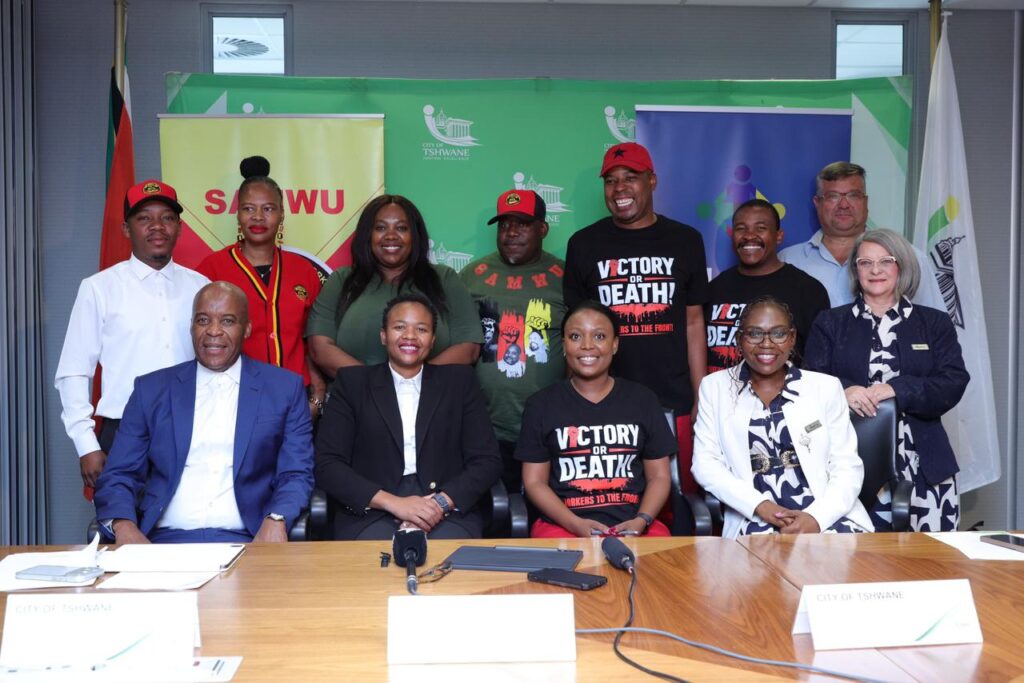
 Tshwane Coalition partners with members of Unions photo supplied
By Dr Nasiphi Moya
Executive Mayor of Tshwane
The above remarks were delivered by the Executive Mayor of the City of Tshwane, Dr Nasiphi Moya, at a joint press conference held with representatives of organised labour, including the South African Municipal Workers’ Union (SAMWU) and the Independent Municipal and Allied Trade Union (IMATU).
The press conference addressed the agreed implementation framework relating to the 3.5 percent wage increase dating back to 2021 and outlined the financial and budgetary measures supporting the settlement.
Good morning.
A warm greeting to the residents of Tshwane who are following this press conference, and to members of the media.
Thank you for being here.
I would like to begin by acknowledging those who have guided this process.
I am joined by the Deputy Executive Mayor and Finance MMC, Cllr Eugene Modise, the MMC for Corporate and Shared Services, Cllr Kholofelo Morodi, and the
Tshwane City Manager, Mr Johan Mettler.
I also want to extend a welcome to the other Members of the Mayoral Committee.
The support of our Multiparty Coalition has been instrumental in getting us to this point.
Thank you for your collective leadership and steady support throughout this process.
We are also joined by representatives of organised labour, whose engagement has
been central to today’s outcome.
•SAMWU Tshwane Regional Chairperson, Lehlogonolo Maphatsoe.
•SAMWU Tshwane Regional Secretary, Donald Monakhisi.
•IMATU Tshwane Regional Chairperson, Melita Baloyi.
•IMATU Tshwane Regional Manager, Lynette Burns-Coetzee.
Your presence reflects a shared commitment to dialogue and responsible resolution.
I also acknowledge the City officials and staff members who have continued to serve residents with dedication during a difficult and protracted period.
Today reflects collaboration, maturity, and shared responsibility.
Let us now turn to the matter before us, the resolution of the 3.5% wage dispute dating back to 2021.
To understand this resolution, we must briefly revisit the events that shaped it.
In September 2021, SALGA, SAMWU and IMATU entered into a three-year salary
agreement.
At the time, the City was under severe financial pressure.
The previous administration applied for exemption from implementing the 3.5% increase for 2021 and the 5.4% increase for 2023.
Those exemption applications were not granted at arbitration.
The matter proceeded to the Labour Court.
The Court granted exemption for 2023 but referred the 2021 increase back to the South African Local Bargaining Council (SALGBC).
When the
2021 application was reheard, the arbitrator issued a final ruling on 31 October 2025.
That ruling created a binding legal obligation to implement the 3.5% increase backdated to 1 July 2021.
If implemented immediately as a lump sum, the total backpay exposure was
approximately R1.55 billion.
An immediate payment of that scale would have placed severe pressure on the City’s finances.
It would have affected commitments to Eskom and other creditors, and it would have placed our fully funded budget from 1 July 2026 at risk.
This administration inherited both the legal obligation and the financial consequences.
We had a choice.
We could continue litigation and prolong uncertainty.
Or we could accept the ruling in good faith and work with organised labour to structure a responsible solution.
We chose resolution.
We accepted that salary backpay is a legal obligation.
It cannot be deferred indefinitely.
Delays would only increase the burden and deepen instability.
At the same time, we rejected the idea that honouring workers must come at the cost of weakening the institution.
With the legal position settled, the responsibility rested with this administration.
The issue was no longer whether the increase must be implemented.
It was how to implement it fairly and sustainably.
An immediate lump sum payment would have amounted to R1,554,939,724.00.
That level of outflow would have placed severe strain on the City’s financial position.
That required engagement rather than extended litigation.
It required partnership and disciplined negotiation.
Before I take you through the proposed agreement, I want to clarify that the proposal
I am about to outline has been approved by the Mayoral Committee yesterday
following structured consultation and agreement with organised labour.
This proposed agreement will be submitted to Council for formal ratification in accordance with due
process, following which it will be submitted for final approval by the SALGBC.
Through structured and constructive discussions with IMATU and SAMWU, we
worked to shape a responsible solution.
The result is a full and final settlement that reduces the backpay liability to R1,088,004,733.95 by calculating it on basic salary only.
This represents a reduction of R466,935,990.05 compared to the original exposure.
The agreement covers 21,089 employees.
Salaries will increase by 3.5% with effect from 1 March 2026.
This increase will apply to both the basic salary and benefits.
Back pay will be paid over three years and calculated from 1 July 2021 on basic salary only.
Payment will be staggered, beginning with the lowest TASK levels.
•In 2026, TASK levels 1 to 6, covering 8,139 employees, will be paid in June, August and October.
•In 2027, TASK levels 7 to 10, covering 8,224 employees, will be paid in February, May and December.
•In 2028, TASK levels 11 to 18, covering 4,601 employees, will be paid in April, August and November.
In 2029, TASK levels 19 to 22, covering 125 employees, will be paid in February.
The deliberate prioritisation of lower income employees is central to this agreement.
Those who earn the least will receive their backpay first.
Importantly, those employees who leave the City of Tshwane either through retirement or resignation, will be paid their outstanding back pay on exit.
This settlement honours workers while safeguarding service delivery and long-term fiscal health.
This naturally raises the question of affordability.
The settlement is supported by the 2025/26 Adjustment Budget currently before Council.
To be clear, the budget remains fully funded, with an operating surplus of
R1,208,052,105.
This confirms that the settlement has been absorbed without destabilising the City’s financial framework.
To accommodate phase one of this inherited obligation, departments identified targeted reductions in non-strategic and discretionary expenditure.
At the same time, allocations to key service delivery areas have increased.
Energy and Electricity has received an additional R109 million to strengthen the 11kV cable network, upgrade substations, replace obsolete equipment, and support distribution stability.
Water and Sanitation has received an additional R147 million to replace worn-out pipes, rehabilitate sewer networks, upgrade pump stations, and strengthen water conservation measures.
A further R15 million has been allocated to enhance internal emergency water supply capacity.
These are investments in reliability and resilience.
No frontline services have been defunded.
No core infrastructure programme has been withdrawn.
This settlement has been structured within a funded budget that continues to prioritise electricity stability, water security, and service delivery.
We are honouring our obligations to workers while strengthening the services
residents depend on.
That is the balance we were determined to achieve.
And so, as we conclude, let me end with clarity.
Residents deserve facts, not fear.
They deserve transparency about decisions that affect workers and service delivery in our City.
This administration has taken a responsible and balanced approach to resolving this matter.
We faced a complex legal and financial challenge.
We addressed it directly.
We have honoured our legal obligations to workers while protecting the financial stability of the City.
The settlement protects employees’ rights.
It preserves service delivery.
It safeguards a fully funded budget.
This is disciplined governance in action.
This agreement closes a long chapter of uncertainty.
It demonstrates that even after strain and disagreement, constructive engagement can prevail.
In closing, we extend my sincere appreciation to SAMWU and IMATU for their constructive engagement throughout this process and for working with us in a spirit of partnership, mindful of the financial constraints facing the City.
Tshwane moves forward with stability, with partnership, and with purpose.
Thank you.
Tshwane Talks readers have been able to read stories in this publication for free for over two years now. We still want our readers to access our stories for free, but we are asking those among our readers who can afford it to contribute at least R30 a month to cover some of the costs of publishing this independent, non-aligned online newspaper which gives a voice to all sectors of society irrespective of race, colour, creed, religion, or political affiliation. You may make your contribution by depositing at least R30 a month into Tshwane Talks' bank account. Details are as follows:
Bank Details
Bank: Standard Bank
Account Number: 10225548834
Account Type: Cheque Account