
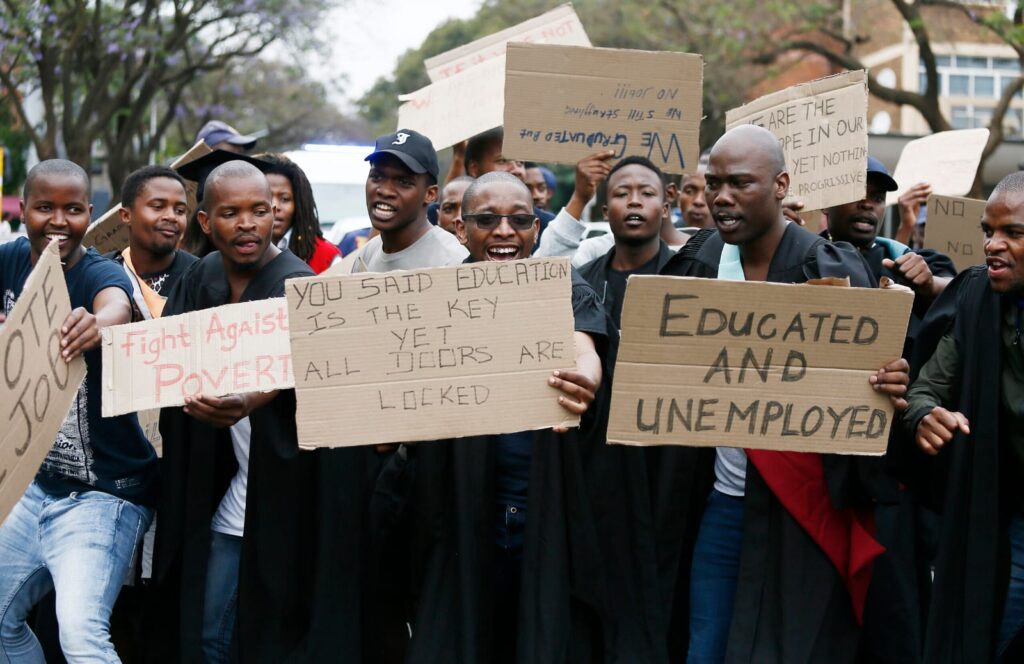
 Unemployed graduates across the country protest wearing their graduation gowns
By Noluthando Pearl Mbonane
When 8.1 Million People Are Jobless, the Numbers Have Faces
South Africa’s unemployment rate climbed to 32.7% in the first quarter of 2026, with 301,000 people losing their jobs in just three months.
Behind that number are 8.1 million human beings who wake up without the dignity of work and without income.
What makes this moment particularly devastating is that the crisis has stopped choosing its victims based on education.
Whether you spent four years at university or never made it past Grade 9, the odds are stacked against you.
The economy is growing at less than 1% annually too slow to absorb the hundreds of thousands entering the workforce every year.
For South Africa’s graduates, the betrayal is personal.
They borrowed money, sacrificed years, endured pressure and many now spend their post-graduation days sending applications into silence.
Graduate unemployment rose to 12.2% in Q1 2026, up 1.8 percentage points from the previous quarter.
Nokuzola Mabadla said “I am a two times University of free state graduate for Social Work, but that no longer matters because in the field that I study for there are no job opportunities.
It’s feels like a waste of time”. Nearly half of all graduates find themselves unemployed or underemployed within their first year of finishing their studies.
Over 220,000 graduates pour out of public universities annually into a job market that cannot accommodate them, increasingly demanding digital and AI-related skills that most curricula never taught.
The uneducated face a harder, older version of the same wall.
Thuli Madonsela explain I’m a high school drop out it’s very hard for me to get a job without matric.
The only place that hires me is in firms were we do hard labour, experiencing long working hours with less payment.
Among South Africans without a matric certificate, unemployment sits at 37.6% above the national average.
These are not people who chose failure. Many come from under-resourced schools and households where survival came before schooling.
Their job market is the narrowest lane imaginable day work, piece jobs, informal labour.
Among young women aged 15 to 24, 39.2% are classified as NEET not in employment, education, or training reflecting not laziness but exclusion on a structural scale.
The root of this crisis runs deeper than individual circumstances.
Infrastructure collapse unreliable electricity, failing logistics, water insecurity has raised the cost of doing business to a point where companies cannot afford to hire.
Corruption has diverted public funds away from skills development and small business support that could have created real employment pipelines.
Meanwhile, automation and artificial intelligence are eliminating entry-level roles faster than new ones are being created, leaving millions stranded between the economy that exists and the one they were prepared for.
Londeka Dladla stated I’m a wits graduate holding a Degree in bachelor’s of Philosophy but I’m working at a retail store.
South Africa cannot afford to normalise a 32.7% unemployment rate.
The human cost is the graduate refreshing an empty inbox, the labourer standing in the cold before sunrise, and the young woman who has stopped looking entirely because hope has run out.
This generation qualified and unqualified deserves an economy built to include them.
Growth must be deliberate, investment must be unlocked, and skills development must urgently align with the reality of a changing world of work.
The question is no longer whether the problem is visible.
It is whether those in power will finally act.
Tshwane Talks readers have been able to read stories in this publication for free for over two years now. We still want our readers to access our stories for free, but we are asking those among our readers who can afford it to contribute at least R30 a month to cover some of the costs of publishing this independent, non-aligned online newspaper which gives a voice to all sectors of society irrespective of race, colour, creed, religion, or political affiliation. You may make your contribution by depositing at least R30 a month into Tshwane Talks' bank account. Details are as follows:
Bank Details
Bank: Standard Bank
Account Number: 10225548834
Account Type: Cheque Account