
By Afrika Mayibuye Youth Movement
This statement is directed to the generation that was promised freedom, yet inhales its ashes.
A generation that inherits neither land nor stable employment,neither functioning education nor secure housing.
Today’s youth live in a digital world owned by multinational corporations, and a political landscape governed by yesterday’s men.
1.YOUTH UNEMPLOYMENT & ECONOMIC EXCLUSION
Unemployment continues to ravage families and communities, with the
expanded definition now exceeding 42.9%.
In 2025, over 12 million South Africans
are unemployed, with Black Africans facing unemployment rates above 36%,
compared to around 7% for white South Africans.
Youth unemployment remains catastrophic.
●In the first quarter of 2025, unemployment among youth aged 15–24
reached 62.4%.
●For those aged 25–34, the rate stood at 40%.
●By the second quarter of 2025, overall national unemployment was 33.2%,
with youth still overwhelmingly excluded.
The minerals that once financed European empires still leave our shores raw,
while the youth who mine them live without food or shelter.
Deindustrialisation and cheap imports have eroded our productive base.
From GEAR in 1996 to the National Development Plan of 2012, economic policy has privileged finance over
factories, and profit over people.
2.POLITICAL DEVELOPMENT
The Government of National Unity, led by the ANC in alliance with the DA, has
failed young people; especially those still carrying the burdens of colonialism and apartheid.
Young graduates speak “fancy English in taverns,” trapped in poverty despite qualifications. Many turn to substance use as a means of survival.
Corruption thrives in public institutions.
Crime escalates unchecked.
Gender-based violence terrorises women and children.
Healthcare disparities deepen.
Workers remain underpaid and exploited. The crisis is structural, not accidental.
3.THE NATIONAL WORKING COMMITTEE OF THE YOUTH MOVEMENT
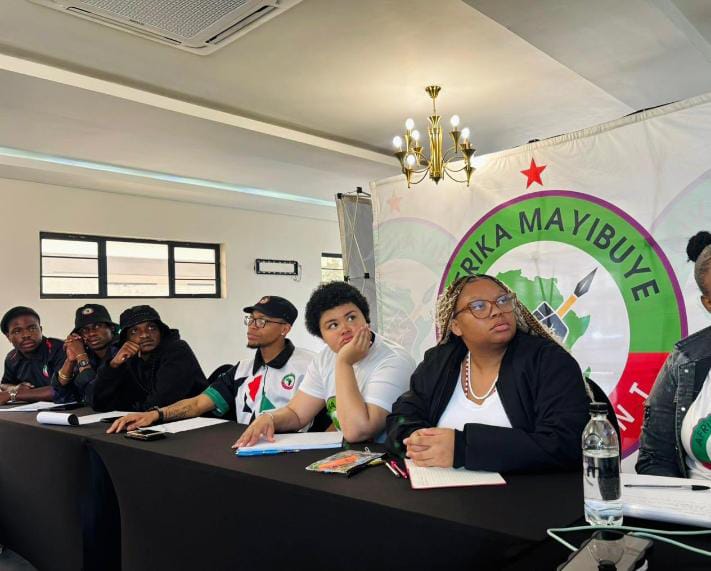
The NWC convened with a clear mission: to sharpen the organisational backbone of the Youth Movement and define the political direction of this generation.
Central to this work was the consolidation of our organisational documents the instruments that ground our identity, guide our activism, and articulate the ideological clarity required to confront the crises facing South Africa’s youth.
But beyond documents, this NWC carried a generational responsibility:
To finalise and strengthen structures across all levels; national, provincial, regional,sub-regional, and branch.
A movement without disciplined, democratic, rooted structures remains an idea.
With them, it becomes an unstoppable force.
This NWC was not administrative; it was historic.
It was about building a Youth Movement capable of organising every street, every campus, every workplace, every rural village, and every township.
This is the work of a generation prepared to lead.
4.COMMISSION REPORTS
Commission 1:
The Collapse of the State Governance, Corruption & Youth-led Renewal South Africa remains a neoliberal state serving the interests of capital while the majority live in poverty.
Institutions are captured by incompetence, nepotism,and criminal networks.
Young people must equip themselves with the skills to rescue the state from maladministration and rebuild it as a vehicle of liberation.
Commission 2:
Youth Unemployment & The New Economic Struggle Youth unemployment is not accidental it is a deliberate outcome of
exclusionary economic design.
Revolutions throughout history have been led by the youth; the economic struggle of our time requires democratic, collective,and political action.
Commission 3:
Education, Skills & the 21st-Century Youth. A revolutionary education must unite scholarship, labour, and lived experience.
Science and technology must address African needs: water purification,
renewable energy, agro-innovation, and public transport.
Commission 4:
Gender-Based Violence, Patriarchy & the Crisis of Masculinity
GBV continues to terrorise communities.
The Youth Movement prioritises the
empowerment and protection of women and children through justice-oriented,
equality-driven policies.
Commission 5:
Land Ownership & the Failure of Transformation
Land must be transferred to the majority through expropriation without compensation.
Agriculture is the backbone of African industrialisation.
A youth-led Green Agrarian Revolution must replace corporate agribusiness with
cooperative farming and public-owned processing infrastructure.
Commission 6:
Digital Colonisation & Technological Sovereignty
The digital age has replaced physical chains with algorithmic ones. Yet the same space holds potential for counter-education, open-source learning, and
Pan-African dialogue.
Technology is a battlefield, the side that controls the code controls the future.
Commission 7:
Race, National Identity & the End of the Reconciliation Project
South Africa remains a country of two nations: dispossessed Black majorities and enriched beneficiaries of
colonialism.
Reconciliation remains impossible without addressing land and property relations.
Commission 8:
Youth Mental Health, Drugs & Social Transformation
Unemployment, trauma, and poverty fuel widespread mental-health crises
among youth.
Interventions must include employment pathways and counselling centres in every ward.
5. ON THE MADLANGA COMMISSION
The Youth Movement commends the principled work of the Madlanga
Commission and the Ad-hoc Committee in exposing political interference in the
criminal justice system.
Their work confirms what youth have long known: justice in South Africa has been manipulated and weaponised.
Yet commissions often produce reports instead of results. Billions have been spent while corruption persists and inequality deepens.
The Youth Movement therefore supports the call by the President of the Afrika
Mayibuye Movement for a Commission of Inquiry into Black People’s Poverty; not
as symbolism, but as a necessity.
For 30 years, the structural conditions that trap Black people in poverty have not been dismantled.
This Commission is essential because:
●No democracy can survive while the majority remains economically exiled.
●Black poverty is engineered, not accidental.
●No public process has fully exposed the economic architecture of Black
dispossession since 1994.
●Young people deserve truth, accountability, and transformation and not recycled promises.
This Commission is about rewriting South Africa’s social contract and confronting
the economic marginalisation of Black people as the central crisis of our time.
CONCLUSION
The Afrika Mayibuye Youth Movement reaffirms that our struggle is far from over.
At this decisive moment in our nation’s history, we call upon millions of young
people in classrooms, in communities, in unemployment queues, and on the
frontlines of survival, to rally behind the banner of:
TOTAL FREEDOM AND EMANCIPATION NOW!
Let history record that when the future of South Africa hung in the balance, the
youth rose uncompromisingly, fearlessly, and determined.
Mayibuye iAfrika!
Tshwane Talks readers have been able to read stories in this publication for free for over two years now. We still want our readers to access our stories for free, but we are asking those among our readers who can afford it to contribute at least R30 a month to cover some of the costs of publishing this independent, non-aligned online newspaper which gives a voice to all sectors of society irrespective of race, colour, creed, religion, or political affiliation. You may make your contribution by depositing at least R30 a month into Tshwane Talks' bank account. Details are as follows:
Bank Details
Bank: Standard Bank
Account Number: 10225548834
Account Type: Cheque Account