

SOUTH AFRICA’S PROPOSED WITHDRAWAL FROM THE 1951 UN REFUGEE CONVENTION: NATIONAL INTERESTS MUST COME FIRST

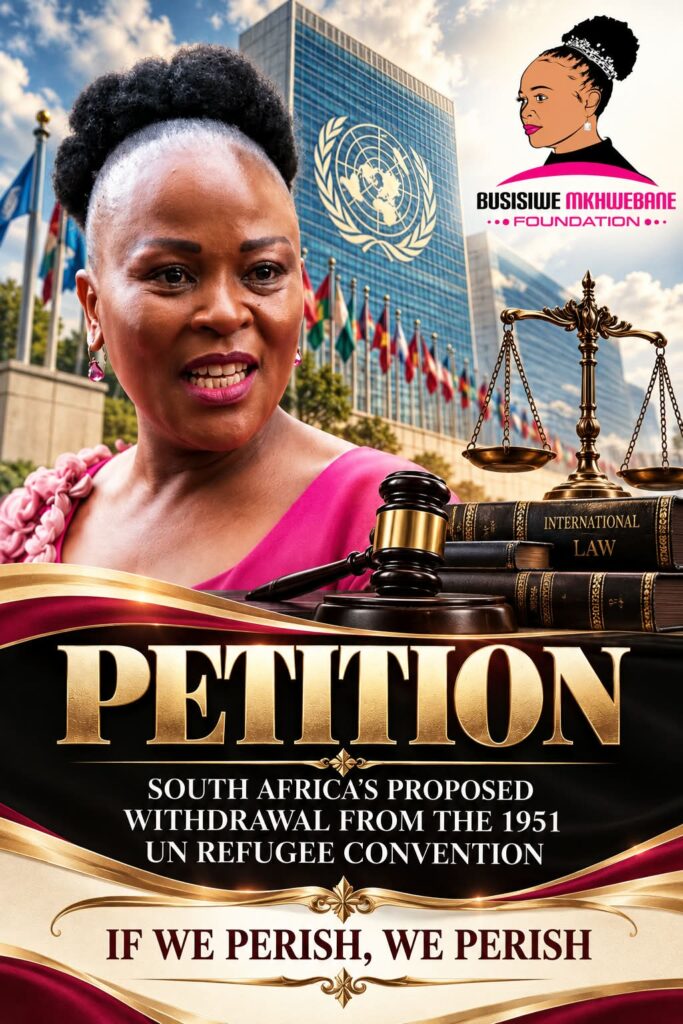 The Busisiwe Mkhwebane Foundation
The BM Foundation expresses serious concern over South Africa’s ongoing refugee and immigration policy debate, particularly proposals to withdraw from the 1951 United Nations Convention Relating to the Status of Refugees.
We believe this debate demands sober reflection on national sovereignty, border security, economic sustainability, human dignity and the government’s constitutional responsibility to its citizens.
South Africans are entitled to demand an immigration system that is orderly, transparent and enforceable.
Communities are experiencing considerable socioeconomic pressures, while unemployment, poverty, housing shortages and the strain on public services remain pressing national challenges.
These concerns cannot simply be dismissed as hostility towards foreign nationals.
Government has a duty to listen to its citizens and ensure that migration is managed in a manner that protects the public interest.
The BM Foundation maintains that international agreements must never become an excuse for administrative paralysis, weak border controls or the failure to enforce domestic laws.
South Africa must retain the practical capacity to identify individuals entering its territory, verify asylum claims, investigate fraudulent documentation and remove persons who have no lawful basis to remain in the country, subject to applicable legal safeguards.
However, withdrawal from the Refugee Convention is not, by itself, a comprehensive solution.
The government must demonstrate that such a step would address the underlying failures of immigration administration rather than merely create the appearance of decisive action. South Africa requires a credible, properly funded and legally sustainable migration management system.
We therefore call on the government to prioritise the following measures:
First, strengthen border security.
Invest in personnel, technology, infrastructure and intelligence-led operations to prevent unlawful crossings and combat trafficking, document fraud and corruption.
Second, reform asylum administration.
Establish efficient screening and adjudication processes, eliminate unnecessary backlogs and ensure that applications are assessed individually, consistently and without abuse of the system.
Third, protect public resources. Develop evidence-based policies that account for the impact of migration on healthcare, education, housing, employment and municipal services.
National planning must recognise the needs of vulnerable South African communities.
Fourth, pursue regional cooperation.
Work with neighbouring states to address irregular migration, share relevant information and develop practical arrangements for lawful returns, where permitted, and the management of asylum claims.
Fifth, demand accountability.
The Department of Home Affairs must regularly report on application backlogs, processing times, enforcement outcomes, staffing and expenditure so that Parliament and the public can assess performance.
The BM Foundation further insists that any decision concerning withdrawal must be subjected to rigorous legal scrutiny, meaningful public consultation and transparent parliamentary consideration.
South Africa’s international obligations must be examined alongside its constitutional commitments and other applicable treaties.
In particular, the prohibition against returning individuals to places where they face persecution, torture or other prohibited harm must not be disregarded.
We reject the false choice between national sovereignty and human dignity.
South Africa can enforce its immigration laws firmly while protecting people who genuinely qualify for refugee protection.
Equally, humanitarian obligations must be accompanied by responsible administration, regional burden-sharing and effective safeguards against exploitation.
The BM Foundation calls for a refugee policy that places South Africa’s national interests first, protects the integrity of the asylum system and restores public confidence in government.
Any proposed withdrawal must be evaluated on its legal consequences, practical benefits and long-term implications for the country, rather than political expediency.
Our position is clear: South Africa needs secure borders, accountable institutions, enforceable laws and a refugee system that is fair, sustainable and consistent with the Constitution.
Support independent community journalism
Help keep Tshwane Talks free to read
Tshwane Talks stories are free to read, and we want to keep it that way. We ask readers who can afford it to contribute at least R30 a month towards the cost of publishing this independent, non-aligned online newspaper.
Tshwane Talks gives a voice to all sectors of society, irrespective of race, colour, creed, religion or political affiliation.
Contribute by bank deposit
- Bank
- Standard Bank
- Account number
- 10225548834
- Account type
- Cheque account
- Suggested
- R30 or more per month
Questions about contributing? Email info@tshwanetalks.com.